Math confidence starts with things kids already know.
Number Battles hides every number inside something real — a rainbow, three little pigs, the legs on a chair. Kids decode it, say the answer, and do it again. Short rounds, real connections, facts that finally stick.
Instant PDF you print at home, made for ages 5–12, with 40+ themes to choose from.
Every number wears an everyday disguise.
Cold digits are hard to love. So Number Battles dresses each one up as something kids can picture. To find the value they have to connect it to the real world first — and that connection is what makes the fact stick.
Now play a 60-second round.
Two cards flip up. Work out each hidden number, type the answer, and fire. Get enough right and you earn a promotion — the cards climb with you, so practice keeps meeting kids right where they are.
Self-checking and screen-free in the printed deck — this is just a taste. Clues start on for new players and switch off as confidence grows; flip them on anytime.
At the table, it plays like War.
Split the deck — 11 cards each. Both players flip at once, decode the hidden values, and the first to shout the answer (the product in a multiplication game, the sum in an addition game) takes both cards. Wipe out your opponent, or hold the most cards when the 5-minute clock runs out, and you win the war.
Both players flip…
Demo runs the 5-minute clock at 5× speed.
Math Challenge
Flip two cards; the first to shout the product (or sum) takes the pile. Pure fluency under pressure.
Classic War
The higher hidden value wins the round; ties go to battle. Perfect for your youngest players.
Why it builds real confidence.
Not louder praise — genuine reps that work, framed so kids want to keep going.
Two brains, one card
Decoding the picture fires language; solving the value fires math. Word-lovers and number-lovers both get a way in.
Safe to be wrong
Cards are self-checking, so mistakes are quiet and quick to fix. No red pen, no audience — just another try.
Grows with the child
Start by matching pictures to numbers; move up to multiplication, division, and estimation on the very same deck.
Screen-free, prep-free
Print, cut, and play in minutes at the kitchen table or a math center. A quick online practice game is there when a screen fits.
Start with a theme they already love.
The math is identical underneath; the costume is whatever lights them up. Every theme is its own deck — tap one to see it.
Both players flip…
Cycles through a different deck every round — same rules, any theme.
One download. Print it once. Battle for years.
Every deck is an instant PDF, sized for cardstock, with rules for two ways to play — a fast fluency race and a gentler version for your youngest players.
New here? General Engagement is the deck to start with — four skill levels in one, so it works for a whole family or a whole class.
- 4 skill levels in one deck — 88 cards, picture clues up to word-only
- 6 practice worksheets — 150 problems, with answer keys
- A study key that decodes every card, so anyone can referee
- A printable Champion’s Certificate to mark mastery
- 40-page instant PDF — print at home, reuse forever
Not ready to buy?
Try a free mini deck first.
Tell us where to send it and we’ll email a free print-and-play mini deck — a full theme’s worth of disguised-number cards plus the rules. Play it at the table tonight, no strings.
- One complete themed mini deck, ready to print
- Both ways to play included
- See exactly how the disguise cards work before you buy
Enter your email just below
No spam — just the deck and the occasional new-theme note. Unsubscribe anytime. For parents & teachers.
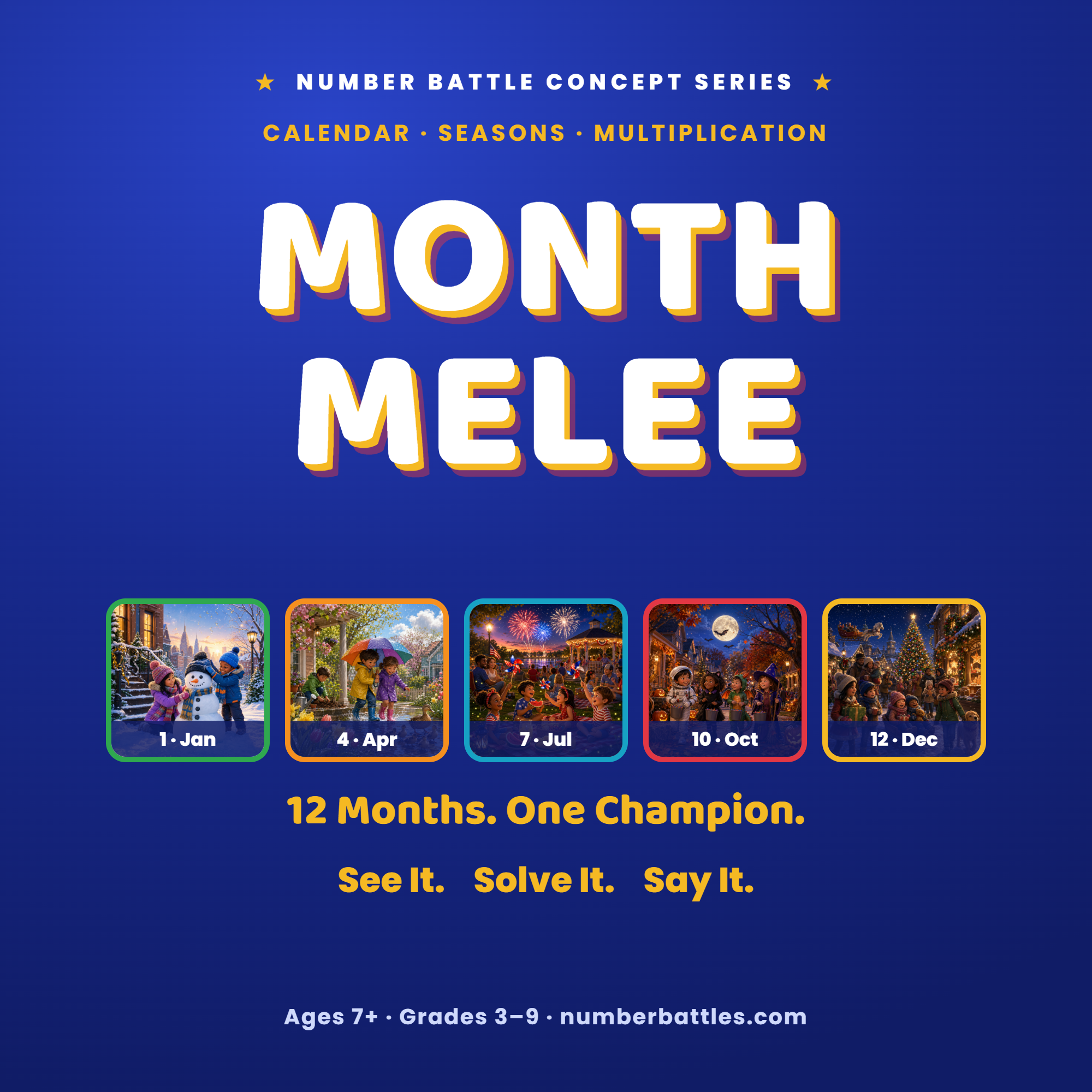
Month Melee — Printable Calendar & Multiplication Card Game
Where numbers clash and champions multiply.
Turn the calendar into a fast-paced multiplication battle. Every month is a number in disguise — January is 1, February is 2, all the way to December at 12. Players flip cards, decode each month's calendar value, multiply, and race to call out the product.
Ages 7+ · Grades 3–9 · 27-page PDF · 4 decks · 150 practice problems
Two ways to play
Number Battle — flip two month cards, multiply their calendar values, and be first to call the product.
Sum of 10 Showdown — find month combinations whose values add up to 12.
Four progressive levels
Rookie — month number, illustrated scene, and name
Challenger — scene and name; students recall the number
Champion — seasonal scene only
Legend — month-name clues plus Calendar Wild Cards
What's included
Game instructions and a calendar reference key
Four printable decks across four skill levels
Four Calendar Wild Cards — Weeks in a Year, Days in a Week, Seasons, Hours in a Day
Original artwork for all twelve months
Six practice worksheets (150 problems) with answer keys
A printable Certificate of Completion
Print, cut, and let the Month Melee begin.
Instant digital PDF download — no physical product will be shipped.
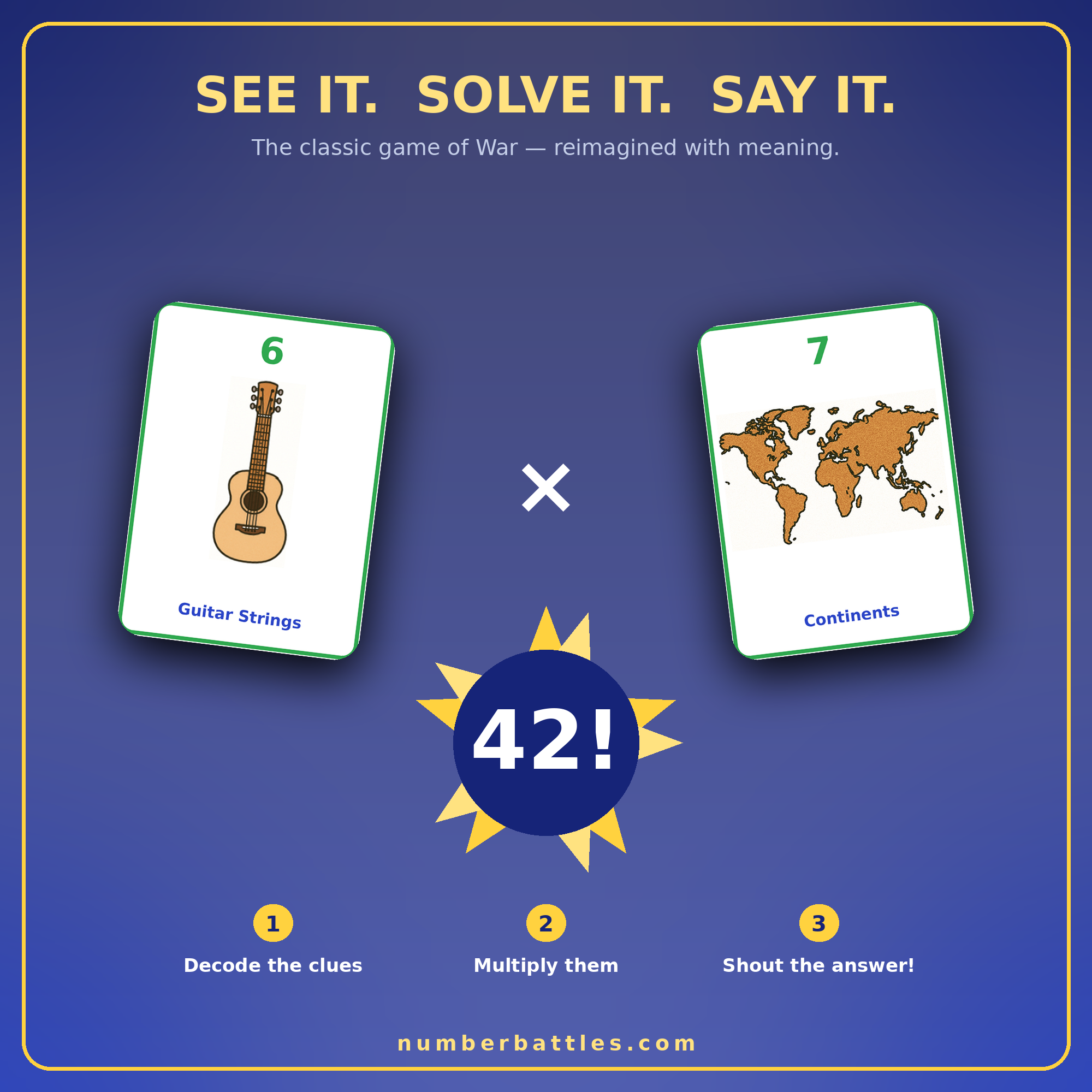
The classic game of War, reimagined with meaning. Instead of a plain "7," a card reads "Continents." Kids decode the clue, multiply, and race to shout the answer. Four skill levels, 150 practice problems, and a champion's certificate — all print-and-play. Ages 7+.
Where Numbers Clash and Champions Multiply.
Number Battle turns everyday facts into fast, friendly math duels. Every card hides a number behind a clue — "Guitar Strings," "Cardinal Directions," "Tentacles (Octopus)." Players flip at the same time, decode both clues, multiply them together, and the first to shout the correct product wins the round. It's the card game War your kids already know, rebuilt to grow number sense, multiplication recall, and lightning mental math.
See It. Solve It. Say It. That simple loop is what makes it stick. Players aren't drilling flash cards — they're competing, reacting, and thinking on their feet. Wild cards keep everyone honest: flip one and you add its value to your opponent's card before multiplying, so a single card can flip the whole battle.
General Engagement II builds recall through clues drawn from the world kids are curious about — geography, science, music, calendars, and history — from the Great Lakes and the Seven Ancient Wonders to a Cyclops, an Octagon, and the thirteen American Colonies.
Four skill levels, one deck of 22 cards. Each level reveals a little less, so players lean harder on memory as they climb:
Level 1 · Easy — number + picture + word
Level 2 · Intermediate — picture + word
Level 3 · Advanced — picture only
Level 4 · Expert — word clue only
Start easy, mix levels for a handicap, and climb to pure-recall Expert. Then reinforce it all with the built-in workbook: six worksheets and 150 problems, complete with answer keys for parents and teachers, plus a Certificate of Completion to celebrate a finished challenge.
Print-and-play. Instant download. No shipping, no waiting. Print at home or in the classroom, cut along the rounded borders, and play in minutes. Perfect for homeschool, math centers, road trips, and rainy afternoons.
Recommended for Ages 7+ · Grades 3–9. A single-player workbook and a two-player (or two-team) game in one download.
WHAT'S INCLUDED (digital download · print-and-play PDF)
How to Play — full rules, four skill levels, and bonus variations
The Study Key — every illustrated clue and the number it stands for
4 Printable Card Decks — one per level, color-coded, 22 cards each
Practice Workbook — 6 worksheets, 150 problems in all
Answer Keys — full solutions for every worksheet
Certificate of Completion — celebrate a finished challenge
Where numbers clash and champions multiply.
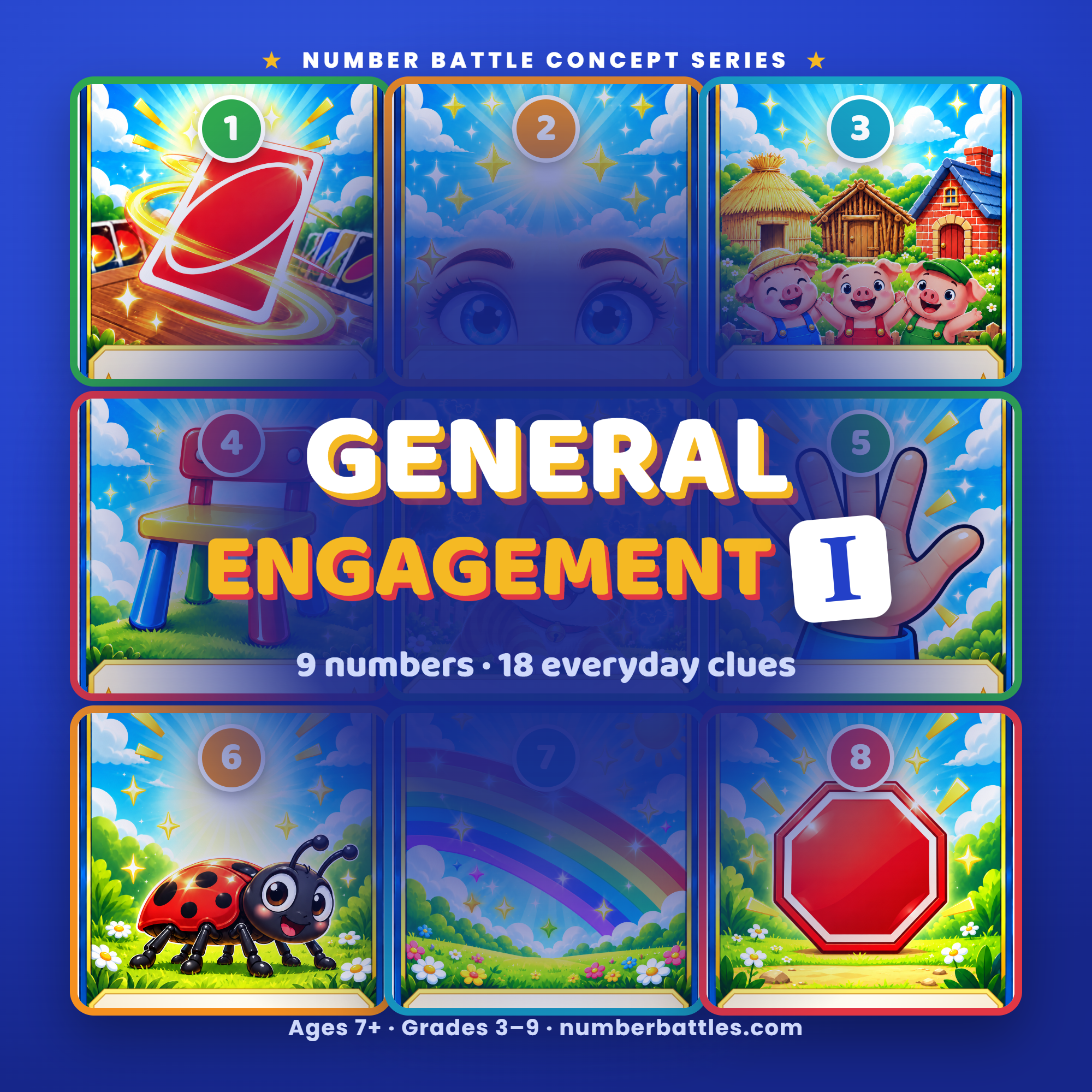
Number Battle: General Engagement I reimagines the classic card game of War — but instead of flipping numbers, players flip picture-and-word clue cards, do the math in their heads, and race to shout the answer first. It's the fact practice kids actually ask to play.
The magic is in the four skill levels. The same 22-card deck comes in four flavors — from simple number-and-picture cards for brand-new learners up to word-only "expert" clues — so one game grows with your child and keeps a whole classroom or family in the fight. See it. Solve it. Say it. First to call the answer takes the card.
It's a print-and-play digital download, so there's no waiting on shipping: download, print, cut along the borders, and you're battling in minutes.
What's included
34 pages
4 Levels Card Decks
18 CLUE CARDS
4 SKILL LEVELS 4 WILD CARDS
225 PRACTICE PROBLEMS
9 WORKSHEETS
Print it once. Battle for years.